Normal Distribution – Numerical Problems with Solutions
Author: Bindeshwar Singh Kushwaha
Platform: PostNetwork Academy
1. Definition of Normal Distribution
A continuous random variable $X$ follows a Normal Distribution with mean $\mu$ and variance $\sigma^2$ if its probability density function (PDF) is:
$$
f(x) = \frac{1}{\sigma \sqrt{2\pi}} e^{ -\frac{(x – \mu)^2}{2\sigma^2} }, \quad -\infty < x < \infty
$$
It is denoted as:
$$
X \sim N(\mu, \sigma^2)
$$
- The curve is symmetric about the mean $\mu$.
- The spread depends on the standard deviation $\sigma$.
2. Writing the PDF of Given Normal Distributions
Example 1
(a) If $X \sim N(10, 25)$
$$
f(x) = \frac{1}{\sqrt{2 \pi 25}} \exp\left( -\frac{(x – 10)^2}{2 \cdot 25} \right)
$$
(b) If $X \sim N(36, 20)$
$$
f(x) = \frac{1}{\sqrt{2 \pi 20}} \exp\left( -\frac{(x – 36)^2}{2 \cdot 20} \right)
$$
(c) If $X \sim N(0, 2)$
$$
f(x) = \frac{1}{\sqrt{2 \pi 2}} \exp\left( -\frac{x^2}{2 \cdot 2} \right)
$$
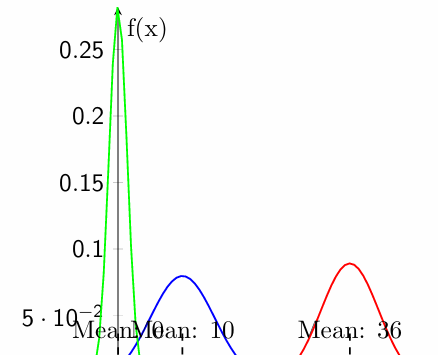
3. Effect of Variance on the Curve
- Larger variance → wider and flatter curve.
- Smaller variance → narrower and taller curve.
For example:
- $N(10,25)$ → Wide spread
- $N(0,2)$ → Narrow distribution
4. Question: Find the PDF
If $X \sim N\left(\frac{1}{2}, \frac{4}{9}\right)$
Solution
Here,
$$
\mu = \frac{1}{2}, \quad \sigma^2 = \frac{4}{9}
$$
Therefore,
$$
\sigma = \frac{2}{3}
$$
Substituting in the standard formula:
$$
f_X(x)=\frac{3}{2\sqrt{2\pi}}e^{-\frac{9(x-\tfrac{1}{2})^2}{8}}
$$
5. Another Example
If $X \sim N(-40,16)$
Here,
$$
\mu=-40, \quad \sigma^2=16
$$
$$
\sigma=4
$$
The PDF becomes:
$$
f_X(x)=\frac{1}{4\sqrt{2\pi}}e^{-\frac{(x+40)^2}{32}}
$$
6. Identifying Parameters from Given PDF
(i)
$$
f(x) = \frac{1}{6\sqrt{2\pi}} \exp\left( -\frac{(x-46)^2}{2 \cdot 36} \right)
$$
Comparing with standard form:
$$
\mu = 46, \quad \sigma^2 = 36
$$
(ii)
$$
f(x) = \frac{1}{\sqrt{2\pi}} \exp\left( -\frac{(x-60)^2}{2 \cdot 16} \right)
$$
$$
\mu = 60, \quad \sigma^2 = 16
$$
7. Finding Mean and Variance
Case (i)
$$
f(x)=\frac{1}{2\sqrt{2\pi}}e^{-\frac{x^2}{8}}
$$
Comparing with standard form:
$$
\mu = 0, \quad \sigma^2 = 4
$$
Case (ii)
$$
f(x)=\frac{1}{2\sqrt{\pi}}e^{-\frac{(x-2)^2}{4}}
$$
$$
\mu = 2, \quad \sigma^2 = 2
$$
Conclusion
The Normal Distribution is one of the most important probability distributions in statistics.
Understanding how to:
- Write the PDF
- Identify mean and variance
- Compare with standard form
- Understand variance effects
is essential for mastering probability and statistical inference.
Follow PostNetwork Academy
- Website: www.postnetwork.co
- YouTube: www.youtube.com/@postnetworkacademy
- LinkedIn: www.linkedin.com/company/postnetworkacademy
- GitHub: www.github.com/postnetworkacademy