Artificial Intelligence

Handling Missing Data and Categorical Features

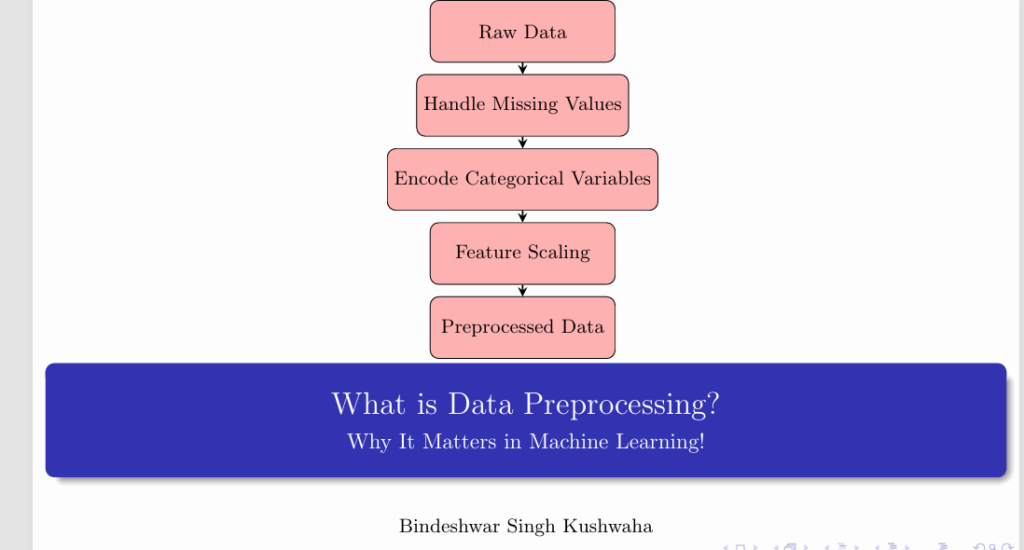
Handling Missing Data and Categorical Features By: Bindeshwar Singh Kushwaha Data Preprocessing Flow Raw Data → Handle Missing Values → Encode Categorical Variables → Feature Scaling → Preprocessed Data Overview of Data Preprocessing Load Titanic dataset from CSV file Handle missing values using various techniques Encode categorical data for machine learning Save the cleaned dataset […]

Handling Missing Data and Categorical Features Read More »

What is Data Preprocessing

What is Data Preprocessing? Why It Matters in Machine Learning! Author: Bindeshwar Singh Kushwaha Real-World Data Challenges Missing or incomplete values Inconsistent formatting and typos Mixed data types (text, numeric, dates) Categorical variables needing encoding Scale variations and outliers What is Data Preprocessing? A set of techniques to clean and prepare raw data Essential for

What is Data Preprocessing Read More »

Poisson Distribution | Data Sc. and A.I. Lect. Series

📘 Understand Poisson Distribution 📌 Introduction In binomial distributions, events’ occurrences and non-occurrences are equally important. However, in real-life situations: Events do not occur as outcomes of fixed number of trials. Events occur randomly over time. Interest lies only in the number of occurrences. Examples: Number of printing mistakes per page in a book. Number

Poisson Distribution | Data Sc. and A.I. Lect. Series Read More »

Binomial Distribution Mean and Variance Related Problems| Data Sc. and A.I. Lect. Series

Binomial Distribution: Mean and Variance Problem 1: Mean = 3, Variance = 4? Given: Is it possible a binomial distribution has a mean of 3 and a variance of 4? Solution: Mean: \( \mu = np \) Variance: \( \sigma^2 = npq \), where \( q = 1 – p \) Given: \( np =

Binomial Distribution Mean and Variance Related Problems| Data Sc. and A.I. Lect. Series Read More »

Fine-Tuning Large Language Models (LLMs) ( DistilGPT-2)

Transfer Learning and Fine-Tuning Large Language Models In this post, we will explore the concept of Transfer Learning, its connection to fine-tuning large language models (LLMs), and step-by-step instructions to fine-tune DistilGPT-2. What is Transfer Learning? Transfer Learning is a powerful machine learning technique where a model trained on one task is reused as the

Fine-Tuning Large Language Models (LLMs) ( DistilGPT-2) Read More »

Fitting Binomial Distribution | Data Science and A.I. Lecture Series

Fitting Binomial Distribution Introduction Fitting a binomial distribution involves comparing observed frequencies with expected frequencies derived from the binomial probability formula. The recurrence relation simplifies the process of finding probabilities. This technique is useful for testing if a dataset follows a binomial distribution. Binomial Probability Function The binomial probability function is: $$p(x) = {n \choose

Fitting Binomial Distribution | Data Science and A.I. Lecture Series Read More »

Moment Generating Function of Binomial Distribution

Moment Generating Function of Binomial Distribution Author: Bindeshwar Singh Kushwaha Institute: PostNetwork Academy Definition of Moment Generating Function The moment generating function (m.g.f.) of a random variable \( X \) is defined as: \[ M_X(t) = E(e^{tX}) \] For a continuous random variable: \[ M_X(t) = \int_{-\infty}^{\infty} e^{tx} f(x) \, dx \] For a discrete

Moment Generating Function of Binomial Distribution Read More »

Moments of Binomial Distribution Video I Data Science and A.I. Lect. Series

  Moments of Binomial Distribution By Bindeshwar Singh Kushwaha — PostNetwork Academy Moment Definition Let \( X \sim B(n, p) \) be a binomial random variable. The \( r^\text{th} \) raw moment about origin: \( \mu_r’ = \mathbb{E}(X^r) = \sum_{x=0}^{n} x^r \cdot \mathbb{P}(X = x) \) First-order moment (mean): \( \mu_1′ = \mathbb{E}(X) \) Binomial

Moments of Binomial Distribution Video I Data Science and A.I. Lect. Series Read More »

©Postnetwork-All rights reserved.