Machine Learning

Handling Missing Data and Categorical Features

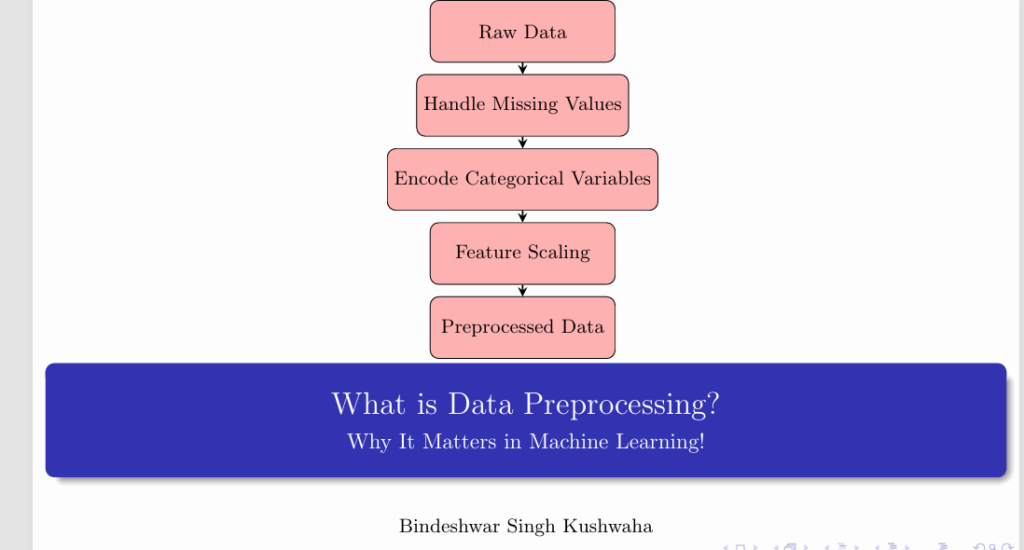
Handling Missing Data and Categorical Features By: Bindeshwar Singh Kushwaha Data Preprocessing Flow Raw Data → Handle Missing Values → Encode Categorical Variables → Feature Scaling → Preprocessed Data Overview of Data Preprocessing Load Titanic dataset from CSV file Handle missing values using various techniques Encode categorical data for machine learning Save the cleaned dataset

Handling Missing Data and Categorical Features Read More »

What is Data Preprocessing

What is Data Preprocessing? Why It Matters in Machine Learning! Author: Bindeshwar Singh Kushwaha Real-World Data Challenges Missing or incomplete values Inconsistent formatting and typos Mixed data types (text, numeric, dates) Categorical variables needing encoding Scale variations and outliers What is Data Preprocessing? A set of techniques to clean and prepare raw data Essential for

What is Data Preprocessing Read More »

Poisson Distribution | Data Sc. and A.I. Lect. Series

📘 Understand Poisson Distribution 📌 Introduction In binomial distributions, events’ occurrences and non-occurrences are equally important. However, in real-life situations: Events do not occur as outcomes of fixed number of trials. Events occur randomly over time. Interest lies only in the number of occurrences. Examples: Number of printing mistakes per page in a book. Number

Poisson Distribution | Data Sc. and A.I. Lect. Series Read More »

Binomial Distribution Mean and Variance Related Problems| Data Sc. and A.I. Lect. Series

Binomial Distribution: Mean and Variance Problem 1: Mean = 3, Variance = 4? Given: Is it possible a binomial distribution has a mean of 3 and a variance of 4? Solution: Mean: \( \mu = np \) Variance: \( \sigma^2 = npq \), where \( q = 1 – p \) Given: \( np =

Binomial Distribution Mean and Variance Related Problems| Data Sc. and A.I. Lect. Series Read More »

Moment Generating Function of Binomial Distribution

Moment Generating Function of Binomial Distribution Author: Bindeshwar Singh Kushwaha Institute: PostNetwork Academy Definition of Moment Generating Function The moment generating function (m.g.f.) of a random variable \( X \) is defined as: \[ M_X(t) = E(e^{tX}) \] For a continuous random variable: \[ M_X(t) = \int_{-\infty}^{\infty} e^{tx} f(x) \, dx \] For a discrete

Moment Generating Function of Binomial Distribution Read More »

Moments of Binomial Distribution Video I Data Science and A.I. Lect. Series

  Moments of Binomial Distribution By Bindeshwar Singh Kushwaha — PostNetwork Academy Moment Definition Let \( X \sim B(n, p) \) be a binomial random variable. The \( r^\text{th} \) raw moment about origin: \( \mu_r’ = \mathbb{E}(X^r) = \sum_{x=0}^{n} x^r \cdot \mathbb{P}(X = x) \) First-order moment (mean): \( \mu_1′ = \mathbb{E}(X) \) Binomial

Moments of Binomial Distribution Video I Data Science and A.I. Lect. Series Read More »

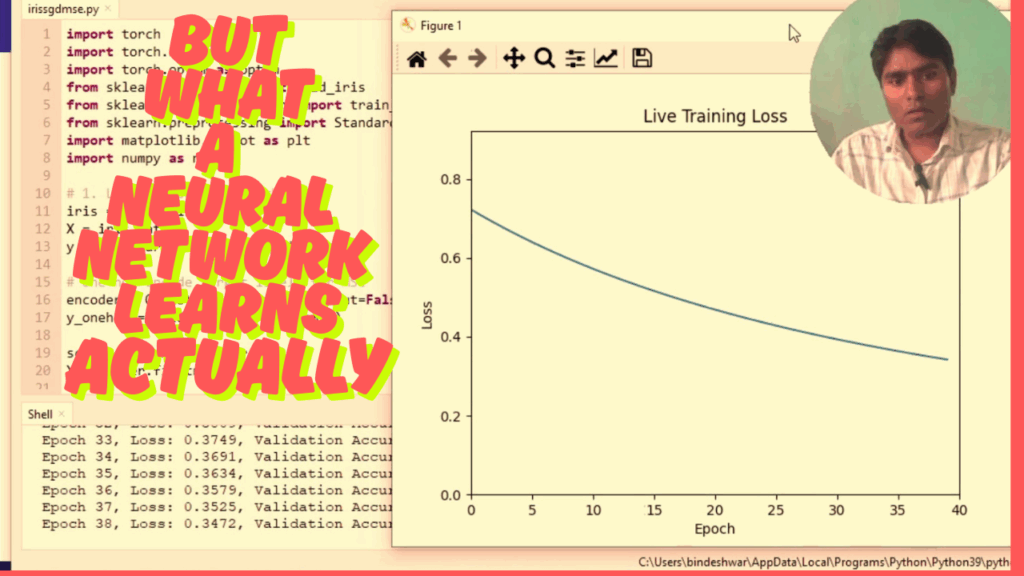
But What A Neural Network Learns Actually: Neural Network Architecture for Iris Data Set

 Neural Network Architecture for Iris Dataset Author: Bindeshwar Singh Kushwaha Institution: PosstNetwork Academy  Outline Iris Dataset Overview Neural Network Architecture Mathematical Formulation Code Walkthrough Live Loss Plot Evaluation and Summary  Sample from Iris Dataset Sepal Length Sepal Width Petal Length Petal Width Class 5.1 3.5 1.4 0.2 Setosa 6.2 2.9 4.3 1.3 Versicolor 5.9 3.0

But What A Neural Network Learns Actually: Neural Network Architecture for Iris Data Set Read More »

©Postnetwork-All rights reserved.