Mathematics

Normal Distribution A Detailed Step-by-Step Explanation

Normal Distribution A Detailed Step-by-Step Explanation By Bindeshwar Singh Kushwaha PostNetwork Academy Introduction: Random Variables A random variable (r.v.) is a function that assigns a numerical value to each outcome of a random experiment. There are two main types of random variables: Discrete Random Variable: Takes countable values (e.g., number of heads in 3 coin […]

Normal Distribution A Detailed Step-by-Step Explanation Read More »
Poisson Distribution | Data Sc. and A.I. Lect. Series

📘 Understand Poisson Distribution 📌 Introduction In binomial distributions, events’ occurrences and non-occurrences are equally important. However, in real-life situations: Events do not occur as outcomes of fixed number of trials. Events occur randomly over time. Interest lies only in the number of occurrences. Examples: Number of printing mistakes per page in a book. Number

Poisson Distribution | Data Sc. and A.I. Lect. Series Read More »

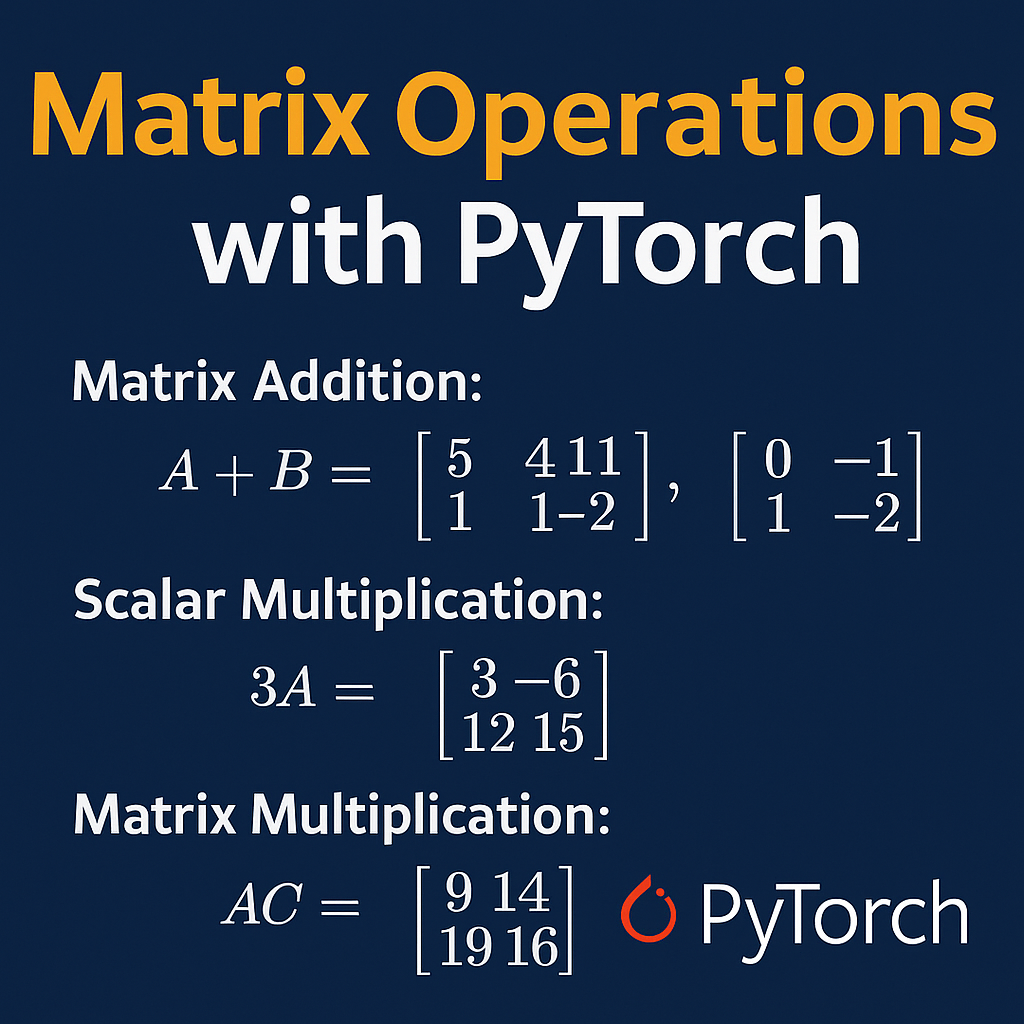
Matrix Operations with PyTorch | Learn Linear Algebra with Code

Matrix Operations with PyTorch Author: Bindeshwar Singh Kushwaha Institute: PostNetwork Academy Matrix Addition and Scalar Multiplication Matrix Addition: We add corresponding elements of the same-sized matrices: \( A + B = [a_{ij} + b_{ij}] \) Scalar Multiplication: Multiply each element of the matrix by the scalar value: \( kA = [k \cdot a_{ij}] \) Example:

Matrix Operations with PyTorch | Learn Linear Algebra with Code Read More »

Binomial Distribution Data Science and A.I. Lecture Series

  Binomial Distribution Data Science and A.I. Lecture Series By Bindeshwar Singh Kushwaha | PostNetwork Academy Binomial Probability Function The binomial probability function is given by: \[ P(X = k) = \binom{n}{k} p^k (1 – p)^{n – k} \] where: \( n \) = total number of trials \( k \) = number of successes

Binomial Distribution Data Science and A.I. Lecture Series Read More »

Bernoulli Distribution in Probability and Statistics

Bernoulli Distribution Data Science and A.I. Lecture Series By Bindeshwar Singh Kushwaha | PostNetwork Academy Introduction to Bernoulli Distribution A Bernoulli trial is an experiment with only two possible outcomes: Success (1) and Failure (0). If p is the probability of success, then q = 1 – p is the probability of failure. A random

Bernoulli Distribution in Probability and Statistics Read More »

Addition, Multiplication Theorem of Expectation and Covariance

Addition, Multiplication Theorem of Expectation and Covariance Data Science and A.I. Lecture Series By Bindeshwar Singh Kushwaha PostNetwork Academy Outline Introduction Addition Theorem of Expectation Proof of Addition Theorem Multiplication Theorem of Expectation Proof of Multiplication Theorem Covariance Introduction Expectation (or expected value) is a fundamental concept in probability and statistics. It provides a measure

Addition, Multiplication Theorem of Expectation and Covariance Read More »

Moments and Other Measures in Terms of Expectations

  Moments and Other Measures in Terms of Expectations Data Science and A.I. Lecture Series By Bindeshwar Singh Kushwaha – PostNetwork Academy Moments The \( r^{th} \) order moment about any point \( A \) of a variable \( X \) is given by: For discrete variables: \[ \mu_r’ = \sum_{i=1}^{n} p_i (x_i – A)^r

Moments and Other Measures in Terms of Expectations Read More »

Mathematical Expectation

Mathematical Expectation Data Science and A.I. Lecture Series By Bindeshwar Singh Kushwaha – PostNetwork Academy Introduction This unit explores the expectation of a random variable. Expectation provides a measure of central tendency in probability distributions. Expectation is useful in both discrete and continuous probability distributions. Problems and examples help in understanding practical applications. Objectives Define

Mathematical Expectation Read More »

Bivariate Continuous Random Variables

  Bivariate Continuous Random Variables Introduction A bivariate continuous random variable extends the concept of a single continuous random variable to two dimensions. It describes situations where two variables vary continuously and have some form of dependence or interaction. Understanding these concepts is fundamental in probability theory, statistics, and data science. Objectives Define bivariate continuous

Bivariate Continuous Random Variables Read More »

©Postnetwork-All rights reserved.