Machine Learning

Normal Distribution – Numerical Problems with Solutions

Normal Distribution – Numerical Problems with Solutions Author: Bindeshwar Singh Kushwaha Platform: PostNetwork Academy 1. Definition of Normal Distribution A continuous random variable $X$ follows a Normal Distribution with mean $\mu$ and variance $\sigma^2$ if its probability density function (PDF) is: $$ f(x) = \frac{1}{\sigma \sqrt{2\pi}} e^{ -\frac{(x – \mu)^2}{2\sigma^2} }, \quad -\infty < x […]

Normal Distribution – Numerical Problems with Solutions Read More »
Normal Distribution A Detailed Step-by-Step Explanation

Normal Distribution A Detailed Step-by-Step Explanation By Bindeshwar Singh Kushwaha PostNetwork Academy Introduction: Random Variables A random variable (r.v.) is a function that assigns a numerical value to each outcome of a random experiment. There are two main types of random variables: Discrete Random Variable: Takes countable values (e.g., number of heads in 3 coin

Normal Distribution A Detailed Step-by-Step Explanation Read More »

Support Vector Machines Made Easy | SVM Explained with Example

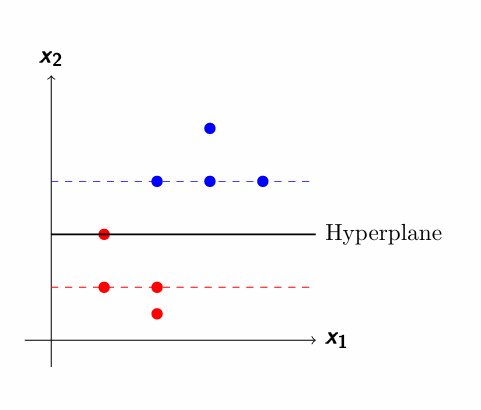
Support Vector Machine (SVM) A Simple Numerical Example – Detailed Explanation Author: Bindeshwar Singh Kushwaha PostNetwork Academy Introduction: Type and Purpose of SVM Type of Algorithm: Supervised Machine Learning Algorithm Used for Classification and Regression (SVR) Discriminative Model – finds decision boundaries Known as a Maximum-Margin Classifier Purpose: Find the optimal hyperplane that separates classes

Support Vector Machines Made Easy | SVM Explained with Example Read More »

Naive Bayes Classification Algorithm for Weather Dataset

Naive Bayes Classification Algorithm for Weather Dataset Author: Bindeshwar Singh Kushwaha | PostNetwork Academy Introduction to Naive Bayes Classifier Naive Bayes is a probabilistic classification algorithm. It is based on Bayes’ Theorem and the naive independence assumption. Suppose we have a feature vector \(\mathbf{X} = (x_1, x_2, …, x_n)\) and a class \(y\). Bayes Theorem:

Naive Bayes Classification Algorithm for Weather Dataset Read More »

Text Classification with Bag of Words and Naive Bayes

Text Classification with Bag of Words and Naive Bayes Author: Bindeshwar Singh Kushwaha | PostNetwork Academy Understanding Text with Machine Learning Processing and understanding text allows extraction of meaningful information from raw data. Text data can be structured into features that machine learning algorithms can analyze. Machine learning approaches include supervised, unsupervised, and deep learning

Text Classification with Bag of Words and Naive Bayes Read More »

Gradient of Softmax + Cross-Entropy w.r.t Logits

Gradient of Softmax + Cross-Entropy w.r.t Logits Author: Bindeshwar Singh Kushwaha – PostNetwork Academy Goal We want to compute: $$ \frac{\partial L}{\partial z_j} $$ Notation: Logits: \(z = [z_1, z_2, \dots, z_C]\) Softmax: \(\hat{y}_i = \frac{e^{z_i}}{\sum_{k=1}^{C} e^{z_k}}\) Cross-Entropy Loss: \(L = -\sum_{i=1}^{C} y_i \log \hat{y}_i\), where \(y_i\) is one-hot. [Insert Neural Network Diagram Here] Loss

Gradient of Softmax + Cross-Entropy w.r.t Logits Read More »

Understanding Neural Networks: Softmax, Cross-Entropy, and Backpropagation

Understanding Neural Networks: Softmax, Cross-Entropy, and Backpropagation Author: Bindeshwar Singh Kushwaha – PostNetwork Academy Neural Network with Softmax + Cross-Entropy Input Layer: The network receives 3 input features, denoted \(x_1, x_2, x_3\). Hidden Layer: 2 neurons in the hidden layer with activations \(a^{(1)}\) and \(a^{(2)}\). Output Layer: 2 outputs \(z^{(3)}, z^{(4)}\), passed through softmax. Softmax

Understanding Neural Networks: Softmax, Cross-Entropy, and Backpropagation Read More »

Feature Scaling in Machine Learning : Preprocessing Technique

Feature Scaling in Machine Learning Author: Bindeshwar Singh Kushwaha Postnetwork Academy Why Feature Scaling? Machine learning algorithms often struggle when input features have different scales. Example: Total number of rooms might range from 6 to 39,320, while median incomes range from 0 to 15. Two common methods to scale features: Min-Max Scaling (Normalization) Standardization Min-Max

Feature Scaling in Machine Learning : Preprocessing Technique Read More »

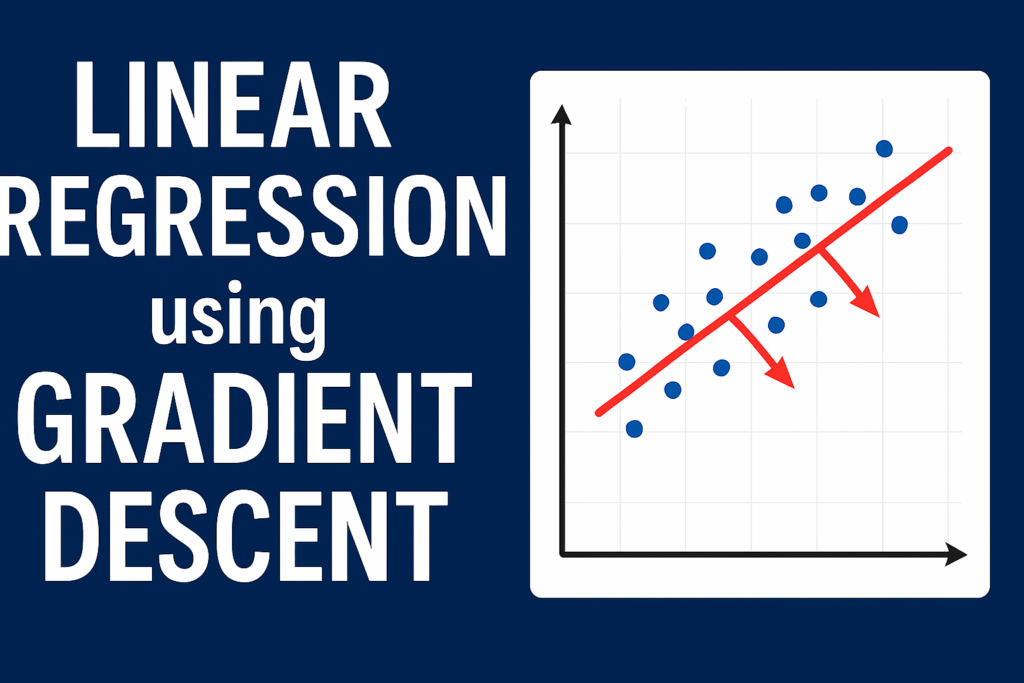
Linear Regression using Gradient Descent

  Linear Regression using Gradient Descent By Bindeshwar Singh Kushwaha General Linear Regression Model We have a collection of labeled examples: $$ \{(\mathbf{x}_i, y_i)\}_{i=1}^{N} $$ \( \mathbf{x}_i \) is a \( D \)-dimensional feature vector \( y_i \) is a real-valued target Each feature \( x_i^{(j)} \in \mathbb{R} \), where \( j = 1, …,

Linear Regression using Gradient Descent Read More »

Label Encoding and One Hot Encoding in Machine Learning

📘 Label Encoding and One-Hot Encoding Author: Bindeshwar Singh Kushwaha 🎯 Encoding Categorical Features 🔹 Label Encoding Assigns each category an integer value Suitable for ordinal data (e.g., size: small, medium, large) Tool: LabelEncoder from sklearn.preprocessing Example (Titanic): Encoding Sex as 0 (male), 1 (female) 🔹 One-Hot Encoding Converts categories into binary columns (one per

Label Encoding and One Hot Encoding in Machine Learning Read More »

©Postnetwork-All rights reserved.