Probability Theory

Normal Distribution A Detailed Step-by-Step Explanation

Normal Distribution A Detailed Step-by-Step Explanation By Bindeshwar Singh Kushwaha PostNetwork Academy Introduction: Random Variables A random variable (r.v.) is a function that assigns a numerical value to each outcome of a random experiment. There are two main types of random variables: Discrete Random Variable: Takes countable values (e.g., number of heads in 3 coin […]

Normal Distribution A Detailed Step-by-Step Explanation Read More »
Negative Binomial Distribution | Simple Explanation #177 Data Sc. and A.I. Lect. Series

Negative Binomial Distribution A Detailed Step-by-Step Explanation By Bindeshwar Singh Kushwaha PostNetwork Academy Introduction: Relation with Geometric Distribution The negative binomial distribution is a generalization of the geometric distribution. It describes the number of failures before the \( r^{th} \) success in a sequence of Bernoulli trials. When \( r = 1 \), it reduces

Negative Binomial Distribution | Simple Explanation #177 Data Sc. and A.I. Lect. Series Read More »

Support Vector Machines Made Easy | SVM Explained with Example

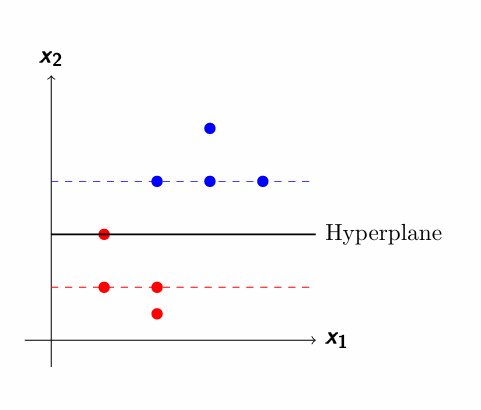
Support Vector Machine (SVM) A Simple Numerical Example – Detailed Explanation Author: Bindeshwar Singh Kushwaha PostNetwork Academy Introduction: Type and Purpose of SVM Type of Algorithm: Supervised Machine Learning Algorithm Used for Classification and Regression (SVR) Discriminative Model – finds decision boundaries Known as a Maximum-Margin Classifier Purpose: Find the optimal hyperplane that separates classes

Support Vector Machines Made Easy | SVM Explained with Example Read More »

Learn about the Discrete Uniform Distribution in probability and statistics with detailed explanations, examples, formulas, and visualizations. Understand its mean, variance, and applications such as die rolls and expected frequency calculations. Presented by Bindeshwar Singh Kushwaha, PostNetwork Academy.

Discrete Uniform Distribution in Statistics

Discrete Uniform Distribution By: Bindeshwar Singh Kushwaha PostNetwork Academy Discrete Uniform Distribution A random variable \( X \) is said to have a discrete uniform distribution if it takes integer values from \( a \) to \( b \) with equal probability. The number of possible values is \[ n = b – a +

Discrete Uniform Distribution in Statistics Read More »

Naive Bayes Classification Algorithm for Weather Dataset

Naive Bayes Classification Algorithm for Weather Dataset Author: Bindeshwar Singh Kushwaha | PostNetwork Academy Introduction to Naive Bayes Classifier Naive Bayes is a probabilistic classification algorithm. It is based on Bayes’ Theorem and the naive independence assumption. Suppose we have a feature vector \(\mathbf{X} = (x_1, x_2, …, x_n)\) and a class \(y\). Bayes Theorem:

Naive Bayes Classification Algorithm for Weather Dataset Read More »

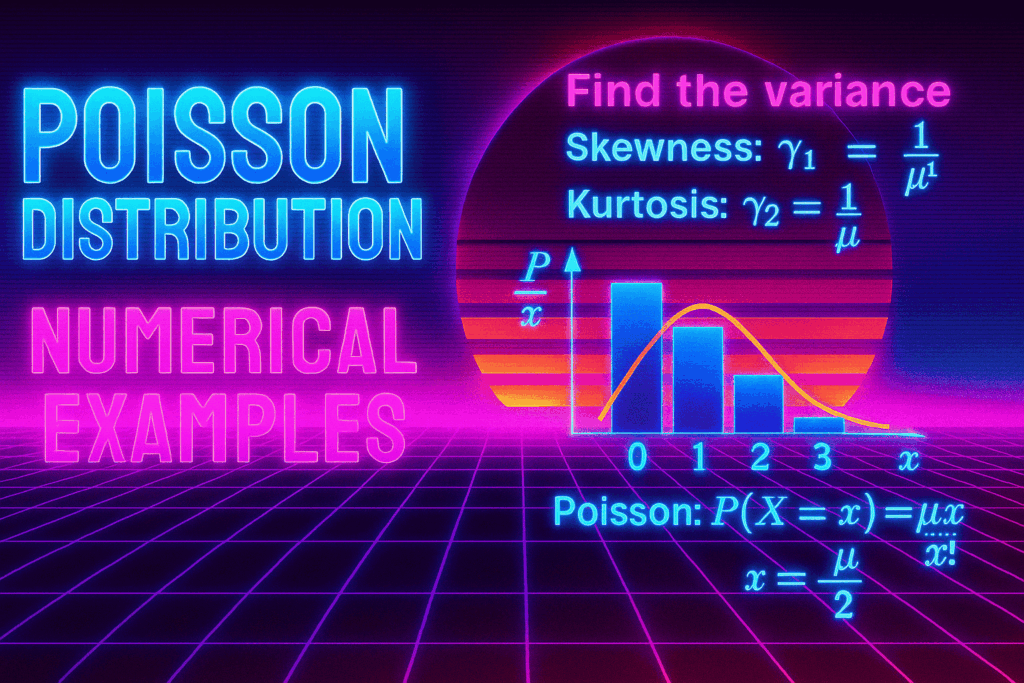
Poisson Distribution Numerical Examples

📘 Poisson Distribution Numerical Examples Author: Bindeshwar Singh Kushwaha Institution: PostNetwork Academy Example 1: Truck Arrivals The number of heavy trucks arriving at a railway station follows a Poisson distribution with an average of 2 arrivals per hour. Find: (a) Probability that no truck arrives (b) Probability that at least two trucks arrive Let \(

Poisson Distribution Numerical Examples Read More »

Binomial Distribution Mean and Variance Related Problems| Data Sc. and A.I. Lect. Series

Binomial Distribution: Mean and Variance Problem 1: Mean = 3, Variance = 4? Given: Is it possible a binomial distribution has a mean of 3 and a variance of 4? Solution: Mean: \( \mu = np \) Variance: \( \sigma^2 = npq \), where \( q = 1 – p \) Given: \( np =

Binomial Distribution Mean and Variance Related Problems| Data Sc. and A.I. Lect. Series Read More »

Moments of Binomial Distribution Video I Data Science and A.I. Lect. Series

  Moments of Binomial Distribution By Bindeshwar Singh Kushwaha — PostNetwork Academy Moment Definition Let \( X \sim B(n, p) \) be a binomial random variable. The \( r^\text{th} \) raw moment about origin: \( \mu_r’ = \mathbb{E}(X^r) = \sum_{x=0}^{n} x^r \cdot \mathbb{P}(X = x) \) First-order moment (mean): \( \mu_1′ = \mathbb{E}(X) \) Binomial

Moments of Binomial Distribution Video I Data Science and A.I. Lect. Series Read More »

Addition, Multiplication Theorem of Expectation and Covariance

Addition, Multiplication Theorem of Expectation and Covariance Data Science and A.I. Lecture Series By Bindeshwar Singh Kushwaha PostNetwork Academy Outline Introduction Addition Theorem of Expectation Proof of Addition Theorem Multiplication Theorem of Expectation Proof of Multiplication Theorem Covariance Introduction Expectation (or expected value) is a fundamental concept in probability and statistics. It provides a measure

Addition, Multiplication Theorem of Expectation and Covariance Read More »

©Postnetwork-All rights reserved.