Python Programming

Normal Distribution – Numerical Problems with Solutions

Normal Distribution – Numerical Problems with Solutions Author: Bindeshwar Singh Kushwaha Platform: PostNetwork Academy 1. Definition of Normal Distribution A continuous random variable $X$ follows a Normal Distribution with mean $\mu$ and variance $\sigma^2$ if its probability density function (PDF) is: $$ f(x) = \frac{1}{\sigma \sqrt{2\pi}} e^{ -\frac{(x – \mu)^2}{2\sigma^2} }, \quad -\infty < x […]

Normal Distribution – Numerical Problems with Solutions Read More »
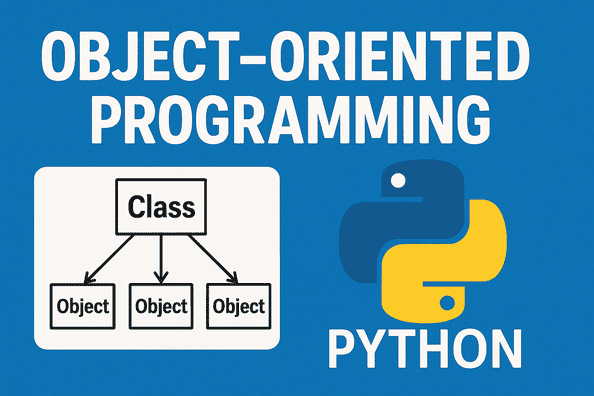
Object-Oriented Programming in Python

   Object-Oriented Programming in Python By: Bindeshwar Singh Kushwaha Institute: PostNetwork Academy What is Object-Oriented Programming (OOP)? OOP is a programming paradigm. It is based on the concept of “objects”. Helps model real-world entities like BankAccount, Student, Car. Makes code more organized, reusable, and easier to maintain. Class in OOP A class is a blueprint

Object-Oriented Programming in Python Read More »

Matrix Operations with PyTorch | Learn Linear Algebra with Code

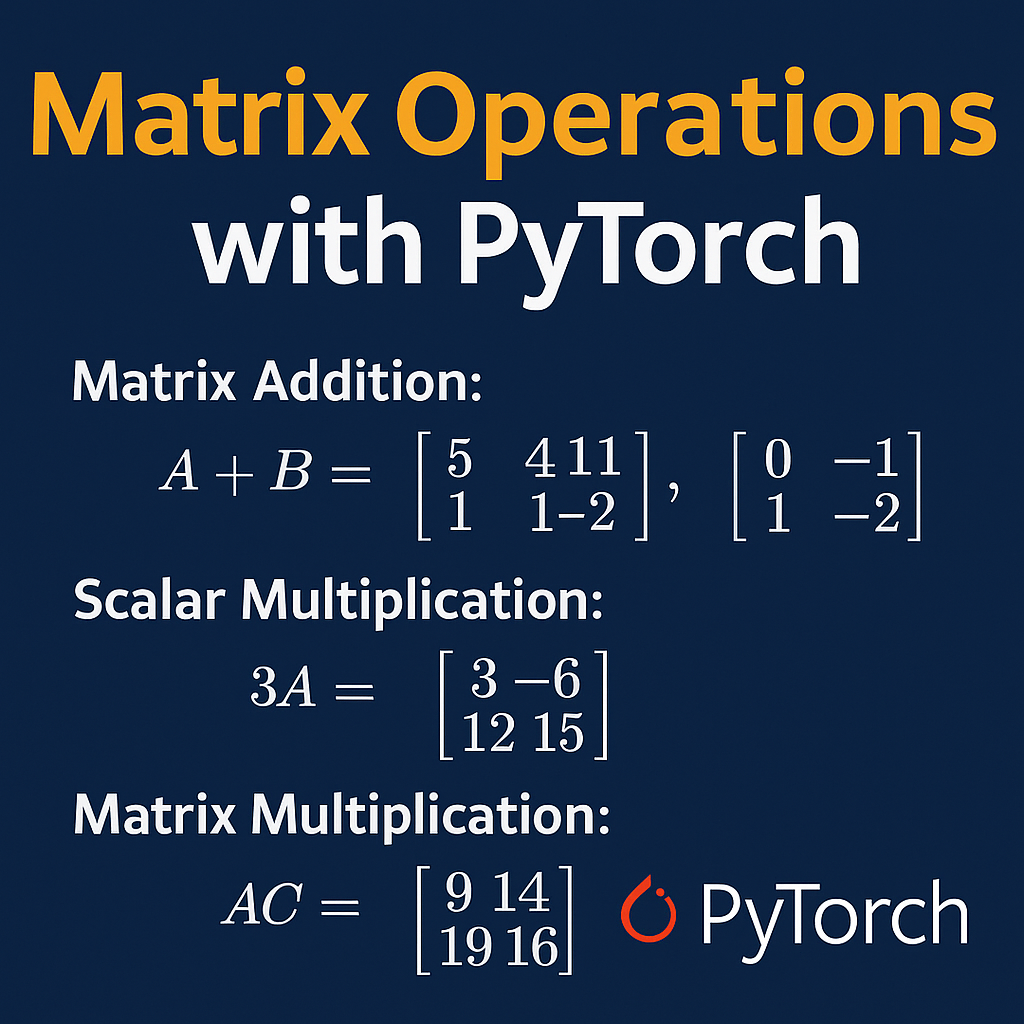
Matrix Operations with PyTorch Author: Bindeshwar Singh Kushwaha Institute: PostNetwork Academy Matrix Addition and Scalar Multiplication Matrix Addition: We add corresponding elements of the same-sized matrices: \( A + B = [a_{ij} + b_{ij}] \) Scalar Multiplication: Multiply each element of the matrix by the scalar value: \( kA = [k \cdot a_{ij}] \) Example:

Matrix Operations with PyTorch | Learn Linear Algebra with Code Read More »

Tensors in Pytorch

Understanding PyTorch: Tensors, Vectors, and Matrices

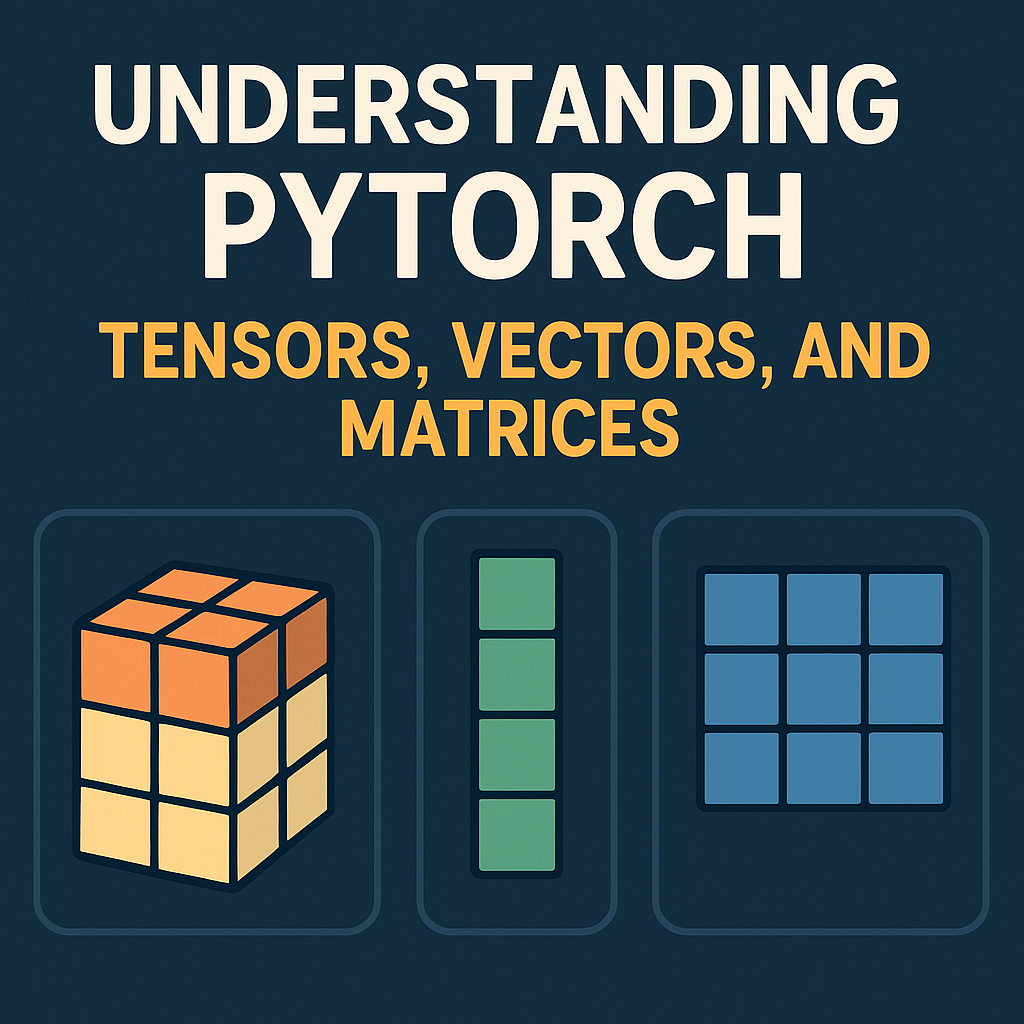
Understanding PyTorch: Tensors, Vectors, and Matrices By: Bindeshwar Singh Kushwaha Institute: PostNetwork Academy What is PyTorch? PyTorch is an open-source deep learning framework. It supports dynamic computation graphs. Designed to be Pythonic and flexible. Commonly used for research and production in AI/ML. Types of Tensors A scalar is a 0-dimensional tensor. A vector is a

Understanding PyTorch: Tensors, Vectors, and Matrices Read More »

Operators in Python Programming

  Operators in Python Data Science and A.I. Lecture Series Author: Bindeshwar Singh Kushwaha | Institute: PostNetwork Academy Introduction Operators in Python are special symbols that perform computations on operands. Python provides various types of operators: Arithmetic Operators Relational Operators Logical Operators Bitwise Operators Assignment Operators Membership Operators Identity Operators Arithmetic Operators a = 10

Operators in Python Programming Read More »

Understanding Input and Output in Python

  Python Input and Output Understanding Input and Output in Python Author: Bindeshwar Singh Kushwaha | Institute: PostNetwork Academy What is Input and Output? In Python, input and output refer to the mechanisms by which a program interacts with users. Input: Data provided by the user using the input() function. Output: Information displayed using the

Understanding Input and Output in Python Read More »

Ordinary Least Squares (OLS) Regression: Step-by-Step Guide with Derivation & Visualization

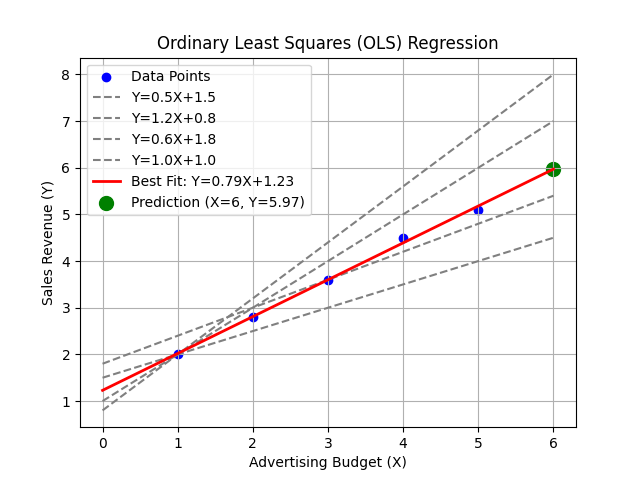
Ordinary Least Squares (OLS) Regression Author: Bindeshwar Singh Kushwaha Institute: PostNetwork Academy Dataset of a Company X (Budget) Y (Sales) 1 2 2 2.8 3 3.6 4 4.5 5 5.1 Description: The dataset represents the relationship between advertising budget (\(X\)) and sales revenue (\(Y\)). The company wants to analyze how the budget affects sales using

Ordinary Least Squares (OLS) Regression: Step-by-Step Guide with Derivation & Visualization Read More »

Tokens in Python

  Tokens in Python Introduction Tokens are the smallest individual units in a Python program. Everything in a Python program is built using tokens. Python has five types of tokens: Keywords: Reserved words in Python. Identifiers: Names given to variables, functions, and classes. Literals: Fixed values such as numbers, strings, and boolean values. Operators: Symbols

Tokens in Python Read More »

©Postnetwork-All rights reserved.