Statistics

Bivariate Continuous Random Variables

  Bivariate Continuous Random Variables Introduction A bivariate continuous random variable extends the concept of a single continuous random variable to two dimensions. It describes situations where two variables vary continuously and have some form of dependence or interaction. Understanding these concepts is fundamental in probability theory, statistics, and data science. Objectives Define bivariate continuous […]

Bivariate Continuous Random Variables Read More »
Bivariate Discrete Cumulative Distribution Function

Bivariate Discrete Cumulative Distribution Function Data Science and A.I. Lecture Series Author: Bindeshwar Singh Kushwaha Institute: PostNetwork Academy Joint and Marginal Distribution Functions for Discrete Random Variables Two-Dimensional Joint Distribution Function The distribution function of the two-dimensional random variable \((X, Y)\) for all real \(x\) and \(y\) is defined as: \[ F(x,y) = P(X \leq

Bivariate Discrete Cumulative Distribution Function Read More »

Bivariate Discrete Random Variables Data Science and A.I. Lecture Series

Bivariate Discrete Random Variables Data Science and A.I. Lecture Series By Bindeshwar Singh Kushwaha, PostNetwork Academy Definition Let \( X \) and \( Y \) be two discrete random variables defined on the sample space \( S \) of a random experiment. Then, the function \( (X, Y) \) defined on the same sample space

Bivariate Discrete Random Variables Data Science and A.I. Lecture Series Read More »

Continuous Cumulative Distribution Function (CDF) | Probability & Statistics

  Definition: Continuous CDF A continuous random variable can take an infinite number of values in a given range. The Probability Density Function (PDF) \( f(x) \) describes the likelihood of \( X \) falling within a small interval. The Cumulative Distribution Function (CDF) is given by: \[ F(x) = P[X \leq x] = \int_{-\infty}^{x}

Continuous Cumulative Distribution Function (CDF) | Probability & Statistics Read More »

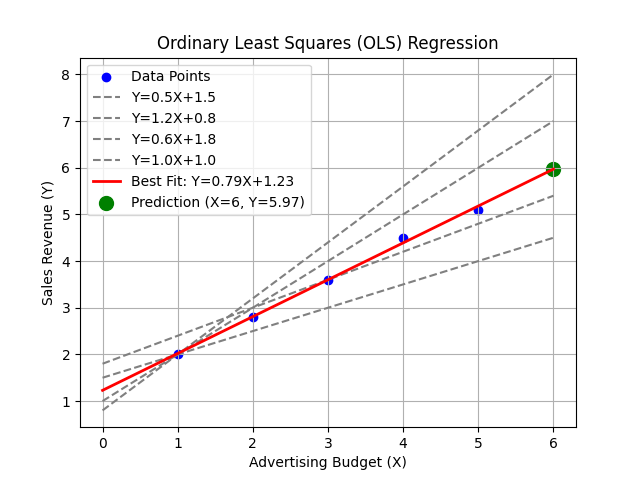
Ordinary Least Squares (OLS) Regression: Step-by-Step Guide with Derivation & Visualization

Ordinary Least Squares (OLS) Regression Author: Bindeshwar Singh Kushwaha Institute: PostNetwork Academy Dataset of a Company X (Budget) Y (Sales) 1 2 2 2.8 3 3.6 4 4.5 5 5.1 Description: The dataset represents the relationship between advertising budget (\(X\)) and sales revenue (\(Y\)). The company wants to analyze how the budget affects sales using

Ordinary Least Squares (OLS) Regression: Step-by-Step Guide with Derivation & Visualization Read More »

Some Questions Based on Continuous Probability Distributions | Data Science & AI Lecture Series

Some Questions Based on Continuous Probability Distributions Question Compute the conditional probability: \[ P\left(X > \frac{3}{4} \mid X > \frac{1}{2}\right) \] Theory Behind Solution The conditional probability formula: \[ P(A | B) = \frac{P(A \cap B)}{P(B)} \] For continuous random variables, probability is computed using integration. Understanding Probability Density Functions A probability density function (p.d.f.)

Some Questions Based on Continuous Probability Distributions | Data Science & AI Lecture Series Read More »

Continuous Random Variable and Probability Density Function

  Continuous Random Variable and Probability Density Function Data Science and A.I. Lecture Series Continuous Random Variable and Probability Density Function A random variable is continuous if it can take any real value within a given range. Instead of probability mass function, we use probability density function (PDF), denoted by \( f(x) \). The probability

Continuous Random Variable and Probability Density Function Read More »

Some Questions Based on Discrete Probability Distributions

Some Questions Based on Discrete Probability Distributions Data Science and A.I. Lecture Series   Problem 1 2 bad articles are mixed with 5 good ones. Find the probability distribution of the number of bad articles if 2 articles are drawn at random. Let \( X \) be the number of bad articles drawn. Possible values:

Some Questions Based on Discrete Probability Distributions Read More »

Random Variables and Probability Distributions

Random Variables and Probability Distributions Introduction to Random Variables In many experiments, we are interested in a numerical characteristic associated with outcomes of a random experiment. A random variable (RV) is a function that assigns a numerical value to each outcome of a random experiment. Example: Consider tossing a fair die twice and defining \(

Random Variables and Probability Distributions Read More »

Bayes’ Theorem and Examples | Data Science & AI

  Bayes’ Theorem and Examples Formula The formula for Bayes’ Theorem is given by: $$ P(E_i | A) = \frac{P(E_i) P(A | E_i)}{\sum_{j=1}^{n} P(E_j) P(A | E_j)} $$ Key Terminology \(E_i\) are hypotheses or possible causes. \(P(E_i)\) is the prior probability of \(E_i\). \(P(E_i | A)\) is the posterior probability of \(E_i\). The denominator ensures

Bayes’ Theorem and Examples | Data Science & AI Read More »

©Postnetwork-All rights reserved.