Probability Theory

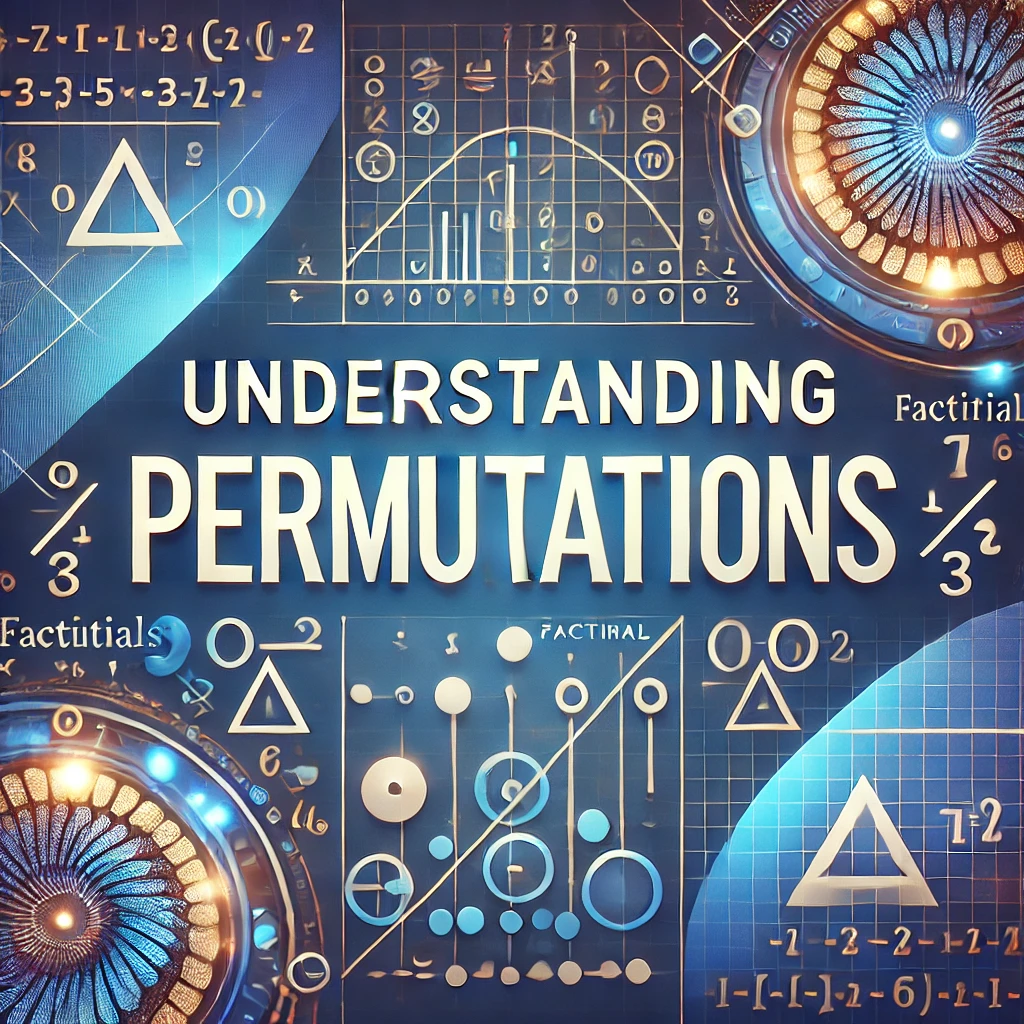
Understanding Permutations

Understanding Permutations Data Science and A.I. Lecture Series Author: Bindeshwar Singh Kushwaha PostNetwork Academy Introduction to Permutations A permutation is an arrangement of objects in a specific order. The order of arrangement is crucial in permutations. Example: Arranging the letters of the word “ABC”. Total permutations = $3! = 6$. Key Formula for Permutations The […]

Understanding Permutations Read More »

probability

Probability Problems based on the Classical Definition of Probability

Probability Problems Based on Classical Definition of Probability Data Science and A.I. Lecture Series   Questions What is the total number of outcomes (sample space)? How do we determine favorable cases? How do probability rules apply to the problem? Example: Throwing Two Dice Find the probability of: A doublet (same number on both dice) Sum

Probability Problems based on the Classical Definition of Probability Read More »

Throwing a Fair Die

Probability Problem: Throwing a Fair Die

  Probability Problem: Throwing a Fair Die Data Science and A.I. Lecture Series Problem Statement A fair die is thrown. Find the probability of: A prime number An even number A number multiple of 2 or 3 A number multiple of 2 and 3 A number greater than 4 Step 1: Sample Space Sample Space:

Probability Problem: Throwing a Fair Die Read More »

Classical or Mathematical Probability Examples

Classical or Mathematical Probability Examples Data Science and A.I. Lecture Series   What You Will Learn The definition and basic concepts of probability. Examples of classical probability problems. Application of probability rules such as complements and odds. Step-by-step solutions to real-world probability problems. Introduction Probability is the study of uncertainty. It provides tools to measure

Classical or Mathematical Probability Examples Read More »

Classical or Mathematical Probability

  Classical or Mathematical Probability Introduction to Probability   Welcome to PostNetwork Academy! This article explains the fundamentals of Classical or Mathematical Probability, including definitions, examples, key characteristics, and limitations. What You Will Learn The definition of Classical Probability and its core formula. Key properties and assumptions of Classical Probability. Examples: Tossing a coin and

Classical or Mathematical Probability Read More »

Exhaustive, Favourable, Mutually Exclusive, and Equally Likely Cases

  Master Probability Concepts: Exhaustive, Favourable, Mutually Exclusive, and Equally Likely Cases Welcome to the Data Science and AI Lecture Series brought to you by PostNetwork Academy. What Will We Learn? Exhaustive Cases: Understanding the total number of outcomes in a random experiment. Favourable Cases: Identifying outcomes that lead to the occurrence of an event.

Exhaustive, Favourable, Mutually Exclusive, and Equally Likely Cases Read More »

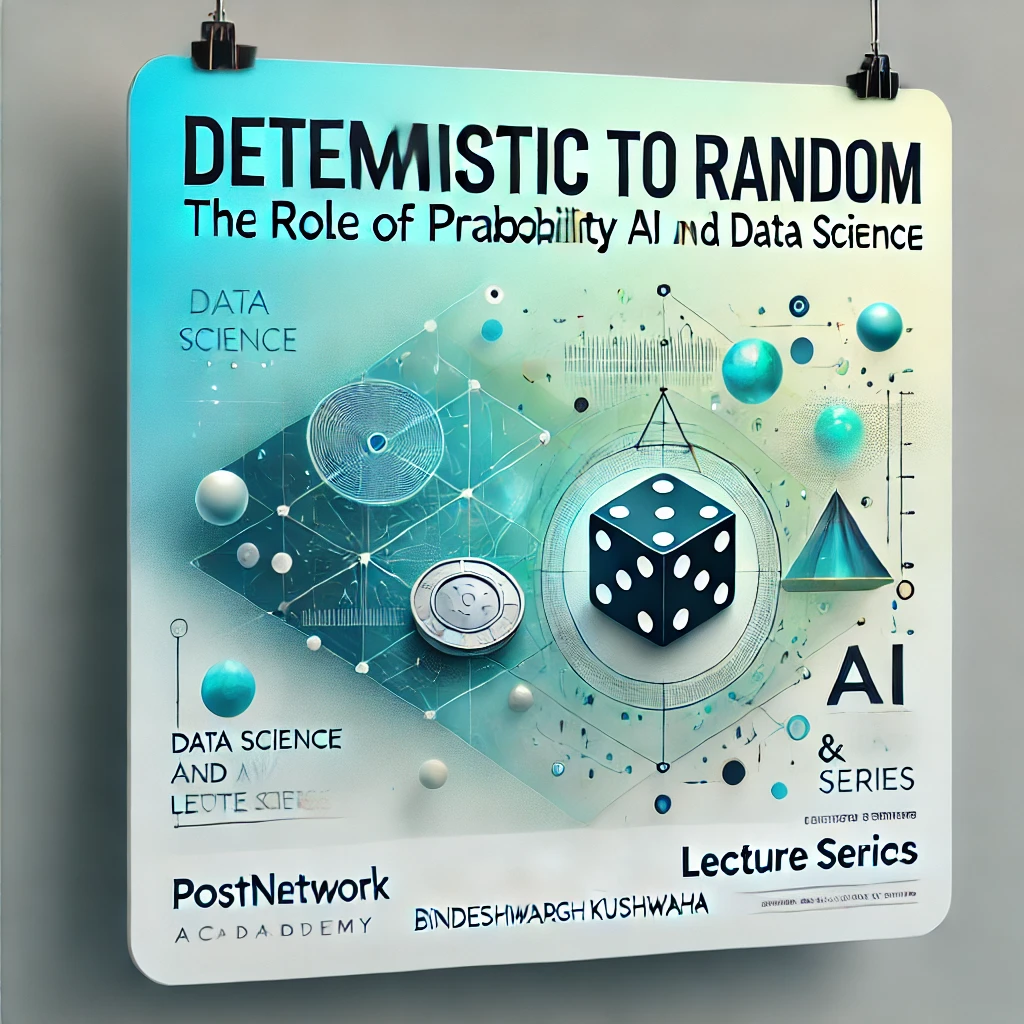
Deterministic to Random: The Role of Probability in AI and Data Sc.

  Deterministic to Random: The Role of Probability in AI and Data Science Introduction An experiment refers to an operation or activity that can produce some well-defined outcome(s). Types of experiments: Deterministic Experiments Random (or Probabilistic) Experiments Deterministic Experiments These experiments have a fixed outcome or result, no matter how many times they are repeated

Deterministic to Random: The Role of Probability in AI and Data Sc. Read More »

Spearman’s Rank Correlation Coefficient

Spearman’s Rank Correlation Coefficient Data Science and A.I. Lecture Series Author: Bindeshwar Singh Kushwaha Institute: PostNetwork Academy Need for Spearman’s Rank Correlation Coefficient In many cases, the relationship between variables is not linear, making Pearson’s correlation coefficient unsuitable. Spearman’s Rank Correlation measures the strength and direction of a monotonic relationship between two variables. It is

Spearman’s Rank Correlation Coefficient Read More »

Karl Pearson’s Correlation Coefficient Numerical Example

  Karl Pearson’s Correlation Coefficient Learn the step-by-step process of finding the correlation coefficient in statistics. Problem Statement Find the Karl Pearson’s coefficient of correlation between \(X\) and \(Y\) for the given data: \[ \begin{aligned} X &: 6, 2, 4, 9, 1, 3, 5, 8 \\ Y &: 13, 8, 12, 15, 9, 10, 11,

Karl Pearson’s Correlation Coefficient Numerical Example Read More »

©Postnetwork-All rights reserved.