Statistics

Why is Covariance Bounded? The Power of Cauchy-Schwarz Inequality Data Science and A.I.

Why is Covariance Bounded? The Power of Cauchy-Schwarz Inequality   Covariance and Standard Deviation Definitions: Sample Covariance: \[ \text{Cov}(X, Y) = \frac{1}{n-1} \sum_{i=1}^n (X_i – \bar{X})(Y_i – \bar{Y}) \] Sample Standard Deviations: \[ \sigma_X = \sqrt{\frac{1}{n-1} \sum_{i=1}^n (X_i – \bar{X})^2}, \quad \sigma_Y = \sqrt{\frac{1}{n-1} \sum_{i=1}^n (Y_i – \bar{Y})^2} \] Cauchy-Schwarz Inequality The Cauchy-Schwarz inequality states: […]

Why is Covariance Bounded? The Power of Cauchy-Schwarz Inequality Data Science and A.I. Read More »
Understanding Correlation: Simplified Explanation

  Understanding Correlation: A Simplified Explanation Welcome to this post in the Data Science and A.I. Lecture Series by Bindeshwar Singh Kushwaha from PostNetwork Academy! Today, we’ll dive into correlation—a crucial concept in data science and statistics. — What is Correlation? In simple terms, correlation measures the strength and direction of the relationship between two

Understanding Correlation: Simplified Explanation Read More »

Covariance

Covariance: A Numerical Example

  Covariance: A Numerical Example Data Science and A.I. Lecture Series   Problem Statement and Table of Deviations Example: Calculate the covariance between the age of husband and wife of the following seven couples. Data: Age of Husband \( X \): 35, 34, 40, 43, 56, 20, 38 Age of Wife \( Y \): 32,

Covariance: A Numerical Example Read More »

Covariance

Covariance Made Simple: Unlocking the Secret of Relationships in Data

  Covariance Made Simple: Unlocking the Secret of Relationships in Data Welcome to Postnetwork Academy! In this post, Bindeshwar explains the concept of covariance, a fundamental tool in statistics and data science. Covariance helps us understand how two variables move together—whether they increase, decrease, or show no relationship at all. What You’ll Learn in This

Covariance Made Simple: Unlocking the Secret of Relationships in Data Read More »

Covariance Explained: Change of Origin vs. Scale Made Simple!

Covariance Explained: Change of Origin vs. Scale Made Simple! Welcome to PostNetwork Academy’s Data Science and AI Lecture Series! In this post, we’ll explore the mathematical concept of covariance and how it behaves under changes of origin and scale. Let’s break it down step by step. Theorem: Covariance Independence We aim to prove that: Covariance

Covariance Explained: Change of Origin vs. Scale Made Simple! Read More »

Bivariate Distribution

Bivariate Distribution Made Simple: From Definition to Covariance Calculation

  Introduction Welcome to the Data Science and AI Lecture Series! In this post, we will simplify the concept of Bivariate Distribution and demonstrate how to calculate Covariance. These are fundamental concepts in statistics for understanding the relationship between two variables. Let’s dive into it! Bivariate Distribution Made Simple: From Definition to Covariance Calculation Author:

Bivariate Distribution Made Simple: From Definition to Covariance Calculation Read More »

Skewness

Measures of Skewness – Data Science and AI Lecture Series

   Measures of Skewness – Data Science and AI Lecture Series In this post, Bindeshwar Singh Kushwaha from PostNetwork Academy explains the concept of  Measures of Skewness. Skewness refers to the lack of symmetry in a data distribution. Understanding skewness is essential in data science and AI, as it helps to interpret the distribution of

Measures of Skewness – Data Science and AI Lecture Series Read More »

Understanding Quartile Deviation: Step-by-Step Calculation & Visualization

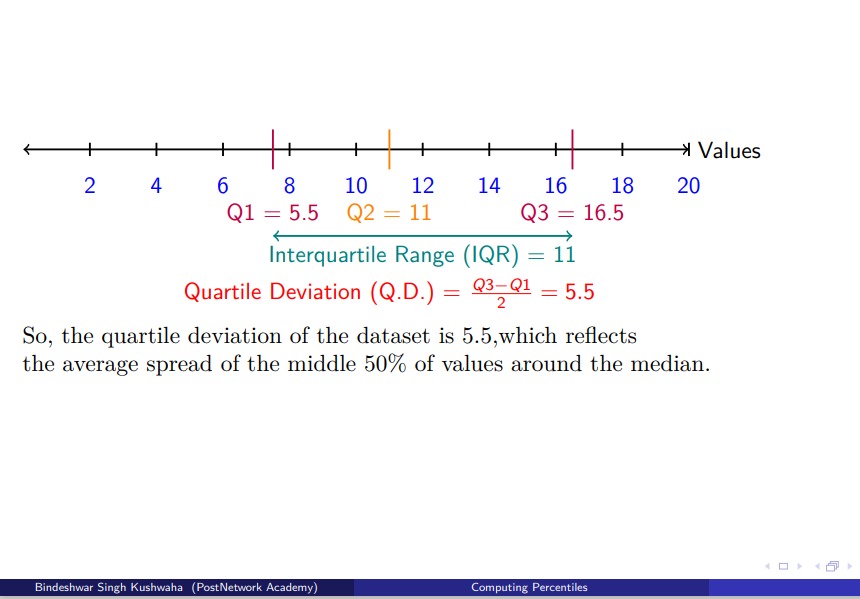
  Understanding Quartile Deviation: Step-by-Step Calculation & Visualization Quartile deviation, also known as the semi-interquartile range, is a useful measure in statistics that helps to understand the spread or dispersion of the middle 50% of a dataset. This post explains how to calculate quartile deviation using a sample dataset, and how to visualize it on

Understanding Quartile Deviation: Step-by-Step Calculation & Visualization Read More »

Data Science and A.I. : How to Calculate Percentiles of Grouped Data

  Data Science and A.I. Lecture Series: Computing the 70th Percentile Welcome to our Data Science and A.I. lecture series! In this post, we’ll cover a fundamental concept in statistics – percentiles. Specifically, we’ll learn how to compute the 70th percentile, or P70, for a grouped data set. Understanding Percentiles Percentiles divide a data set

Data Science and A.I. : How to Calculate Percentiles of Grouped Data Read More »

Data Science and A.I. : How to Calculate Percentiles Step-by-Step Guide

Numerical Example to Compute Percentile Given the data set: 3, 6, 9, 12, 15, 18, 21, 24, 27, 30, 33, 36, 39, 42, 45, 48, 51, 54, 57, 60, calculate the 30th and 60th percentiles. Percentile Percentiles are those values of the variate which divide the distribution into 100 equal parts, therefore the number of

Data Science and A.I. : How to Calculate Percentiles Step-by-Step Guide Read More »

©Postnetwork-All rights reserved.